Trusted school and educational facility cleaning across Sydney — child-safe TGA-registered disinfectants, NHMRC infection control protocols, police-checked and WWCC-cleared staff. Free quote within 24 hours.
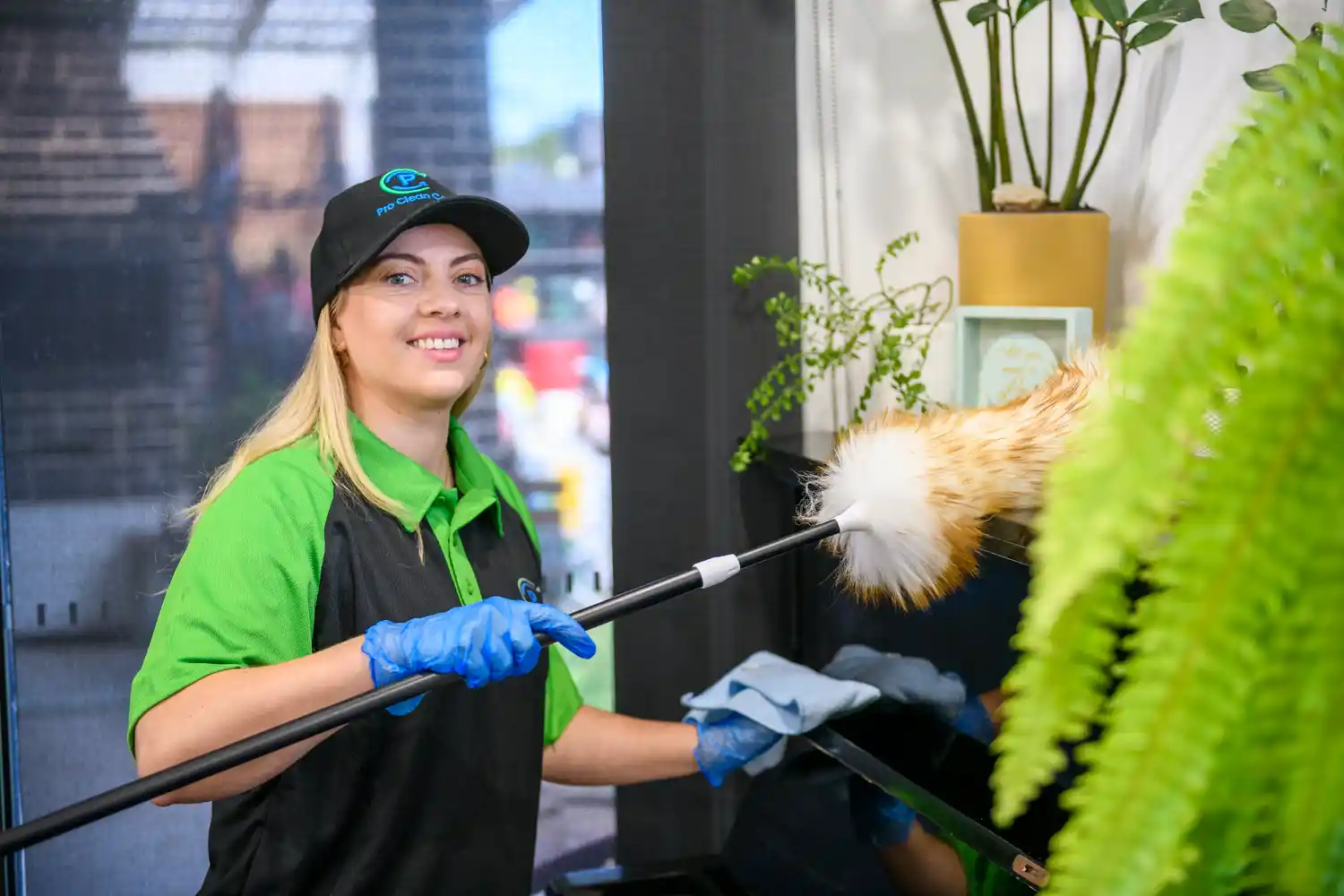
Schools are high-density environments where infection prevention and a consistently clean, safe learning space are directly linked to student health, attendance, and educational outcomes. Pro Clean Corp provides specialist school cleaning services across Sydney for NSW Department of Education public primary schools, high schools, Catholic systemic schools, and independent campuses — using child-safe cleaning products and NHMRC-aligned infection control protocols that protect students and staff throughout every term.
Our programmes operate a strict colour-coded cross-contamination system separating equipment used in restrooms, classrooms, canteens, and common spaces. Every member of our school cleaning team holds a current Working With Children Check and police clearance — essential compliance for any team working in a child-occupied environment in New South Wales. Beyond daily and weekly term maintenance, our structured holiday deep clean programmes address carpet steam cleaning, floor strip and reseal, full toilet block overhauls, window cleaning, and high-level dusting scheduled in advance to align with the school calendar.
High-touch surface disinfection of desks, chairs, whiteboards, door handles, and technology equipment using TGA-registered, child-safe, low-irritant products on every visit.
HACCP-aligned cleaning of all food preparation surfaces, serving equipment, and dining areas to NSW Food Authority standards for school canteens and tuckshops.
Every team member holds a current Working With Children Check and police clearance. Documentation provided to principals and business managers for compliance records.
Intensive term-break cleaning covering carpet steam cleaning, floor restorations, full toilet block overhauls, window cleaning, and high-level dusting across all buildings.
Floor scrubbing, equipment surface wiping, change room sanitisation, and shower area treatment with anti-mould products for school sports and PE facilities.
Dust control, surface disinfection, and floor care for libraries, computer labs, staff rooms, administration offices, and school reception areas.
Free on-site assessment at your school. Written quote within 24 hours. No lock-in contracts.
1300 494 983Online EnquiryEvery zone of your school has specific cleaning and sanitisation requirements. Here is what our teams cover on each visit.
A campus is not one building with one standard. The scope below is what we write into a school proposal, and it is deliberately more specific than a task list — it explains what each area is judged on, because that is what determines how long it takes and what it costs.
The measure of a classroom clean is what a student touches in the first ten minutes of the day: the desk surface, the chair back, the door handle, the light switch, the tap in the sink corner, the shared keyboard or tablet trolley. Those go on every visit with a TGA-registered product held for its stated contact time, not sprayed and immediately wiped. Around that sits floor care — vacuuming carpeted rooms including under the front row where paper and food collect, and mopping vinyl with attention to the door threshold where the corridor grit arrives. Bins are emptied and relined, whiteboards and display surfaces wiped without lifting the pinned work, and reading corners, wet areas and craft sinks reset. Specialist rooms need their own line in the scope: science labs have bench chemistry and eyewash stations, art rooms hold clay and paint residue that a general clean will smear rather than lift, and music rooms need instrument storage left untouched but the floor around it done properly.
The canteen is a food business operating inside a school, and it is cleaned to HACCP-aligned procedures with food-safe products for that reason. Food contact surfaces, servery counters, preparation benches, cooking equipment exteriors, refrigerator and freezer door seals and handles, and the sink and drainage area are all in scope on every service day. Floors are mopped with a food-safe product and the area behind and beneath equipment is included on a rostered basis rather than left until something is spilled. Waste and recycling are moved to the school's collection point and bin areas washed down, since a bin room adjacent to a food area is the fastest way to attract pests onto a campus. Where the canteen is volunteer-run, we agree in writing which tasks belong to the volunteers at close and which belong to the cleaning team afterwards — the boundary between those two is the single most common gap we find on a new school site.
Wet areas are the most labour-intensive part of any campus and the part parents hear about. Every service covers pans, cisterns and seats, basins and taps, mirrors, partitions and door furniture, dispensers refilled with soap and paper, and floors disinfected rather than merely mopped — including the grout, where odour actually lives. Drains are flushed and treated on a rostered basis, ventilation grilles are checked, and any graffiti, damaged fitting or persistent blockage is reported the same night with a photograph rather than cleaned around. Schools with a daytime hygiene requirement add a porter service that checks and restocks blocks between breaks; for most primary schools that single change does more for the reported condition of the toilets than anything else in the contract, because the problem is usually mid-morning, not overnight.
The hall is the room the school is seen in — assemblies, presentation nights, parent evenings — so it is cleaned to a presentation standard rather than a functional one, with floors machine-scrubbed or buffed as the finish requires, stacked seating wiped, stage and stage steps done, and entry glass cleaned at the height a visitor sees it. Gymnasiums and sports halls add equipment surfaces, mats, change rooms and lockers, and shower areas treated with an anti-mould product on a schedule rather than after mould appears. Outdoors, the playground scope covers hard-surface sweeping of courts, walkways and undercroft areas, bin servicing, drinking fountain and bubbler sanitisation, seating and shade-structure posts, and clearing of leaf litter from drains and soft-fall edges. Soft-fall and play equipment inspection is a separate compliance function that belongs to the school or its playground contractor — we report what we see but do not certify it.
The front office is the school's reception and is cleaned as one: counter and sign-in area disinfected, visitor seating wiped, entry glass and door handles done at hand height, floors vacuumed or mopped end to end. Behind it, the staff room kitchen gets a genuine clean rather than a wipe — sink, benches, microwave interior, fridge exterior and handle, dishwasher run or emptied by arrangement — because that is the space staff notice daily. Meeting rooms are reset, printer and shared-equipment surfaces wiped, and staff amenities cleaned to the same standard as student blocks. Principals' and business managers' offices, sick bays and first aid rooms are cleaned to an agreed access protocol, since those rooms hold confidential records and medication and should never be entered by an unaccompanied casual.
Every cleaner rostered to a school holds a current Working With Children Check issued under the Child Protection (Working with Children) Act 2012 NSW and a National Police Clearance. Clearance numbers and expiry dates are held on file and sent to the principal, business manager or facilities coordinator before the first visit rather than produced when asked, and they are re-verified on a rolling basis as expiries fall due. This is the point at which most cleaning contracts quietly fail: the company holds valid clearances, but the person who actually attends on a Thursday night is a subcontractor's casual whose clearance the school has never seen. We employ our cleaners directly, so the WWCC number in your file belongs to the person walking the corridor.
Around that sit the operational controls a school should expect. A named, rostered team rather than a rotating pool, so the same faces are on site and an unfamiliar person is immediately conspicuous. Sign-in and sign-out through the school's own system, not a contractor log. A documented key and alarm-code register with a defined process when a staff member leaves. Photo identification and branded uniforms worn on site. An agreed protocol for the rooms that hold confidential student records, medication or first aid supplies. And a clear instruction to every cleaner that contact with students is limited to what is unavoidable and that any concern is reported to the school, not handled informally — which is the practical, day-to-day expression of the Child Safe Standards a school is accountable for even when the work is contracted out.
Products are part of child safety too, not a separate topic. Everything used in student-occupied areas is TGA-registered, low-irritant and selected for use around children; harsh volatile compounds, high-concentration bleach and phthalate-based products are not used in occupied areas. Safety Data Sheets for every product on site are supplied for the school's WHS records, chemicals are never decanted into unlabelled containers, and nothing is left in an unsecured cupboard at the end of a shift. Schools running a Department of Education contractor induction receive the same documentation pack in the format their compliance system expects.
A school cleaning contract is really two contracts running on one campus. The term-time programme is a high-frequency, low-intensity routine built around the bell: an after-school clean commencing from about 3:30pm, or a before-school start from 5am where a site prefers it, with weekends available for anything that cannot be done around occupancy. It has to flex around the school calendar rather than ignore it — assemblies, exam weeks, parent-teacher evenings, athletics carnivals and hall bookings all move where the crew can be on a given night, and a provider who treats the timetable as an inconvenience will be cleaning around chairs stacked in the wrong room for a fortnight.
Term breaks are the opposite: low frequency, high intensity, and the only window in the year when the intrusive work is possible. Holiday programmes carry hard-floor strip and reseal, carpet steam cleaning, full toilet block overhauls including grout and drainage, high-level dusting of light fittings, ledges and ceiling vents, internal window cleaning, and a genuine reset of specialist rooms — the science lab benches, the art room sinks, the library shelving. Because these tasks are scheduled to fixed dates rather than performed when convenient, the periodic calendar should be agreed at the start of the school year and attached to the contract, dated against the NSW term break weeks.
Two things follow from that split. First, quote them separately: a single monthly figure covering both hides whether the holiday work is genuinely funded, and unfunded periodic work is the reason a campus looks tired by Term 3. Second, use the longer breaks properly — the summer shutdown is long enough for floor finishes to cure and for a full-campus reset that a two-week break cannot accommodate. Our proposals list the term-time scope per visit and the holiday programme against dated weeks. Costs for both are set out on the school cleaning prices Sydney page; for the compliance and screening side in more depth see our school cleaning compliance guide, and for early learning services on the same campus see childcare centre cleaning Sydney.
School cleaning includes daily disinfection of all classrooms, corridors, toilet blocks, canteens, libraries, staff rooms, and administration areas. High-touch surfaces such as desks, chairs, door handles, light switches, and technology equipment are sanitised on every visit using TGA-registered, child-safe products. Regular deep cleans cover sports halls, changing rooms, gymnasium floors, and hard-to-reach areas. Holiday programmes address carpet steam cleaning, floor strip and reseal, full toilet block overhauls, window cleaning, and high-level dusting across all buildings.
Yes. Pro Clean Corp uses only TGA-registered, low-irritant, non-toxic disinfectants throughout all school areas. Our products are specifically selected to be effective against relevant pathogens — including influenza, gastro-causing viruses, and common bacteria — while remaining safe for use in environments occupied by children. We do not use harsh volatile compounds, bleach in high concentrations, or phthalate-based products in occupied school areas. Safety data sheets for every product are available on request for your school's WHS records.
Yes. All standard cleaning is performed before school opens, after school closes, or on weekends to ensure zero disruption to teachers, students, and the learning programme. Our default programme is an after-school clean commencing from 3:30pm. For schools that require daytime hygiene support, we also offer a porter service that operates during school hours to handle reactive needs such as toilet checks, spill response, rubbish removal, and replenishment of soap and hand towels.
Yes. Every member of our school cleaning team holds a current Working With Children Check (WWCC) and has undergone a thorough police background screening before commencing any school work. We maintain records of all clearances and can provide documentation to principals, business managers, or facilities coordinators for DoE compliance purposes or school board records. Our WWCC and police check compliance is reviewed and updated on a rolling basis in line with NSW legislative requirements.
Yes. Pro Clean Corp has experience working within NSW Department of Education public schools and is familiar with the DoE's hygiene, safety, and contractor compliance requirements. Our protocols are aligned with NSW DoE cleaning and hygiene standards, and our teams understand the additional obligations — including WWCC and police clearances, contractor induction procedures, and site-specific safety requirements — applicable to government school sites across Greater Sydney.
Call 1300 494 983 or submit an enquiry via our contact page for a free on-site assessment at your school. We will visit the campus, assess all buildings and cleaning requirements, and provide a detailed written quote within 24 hours. Our quotes are itemised by area and service frequency so your business manager can review costs clearly. There are no lock-in contracts — we earn your ongoing business through consistent quality, not binding terms.
We service primary schools, high schools, and TAFE campuses across Greater Sydney. Find your local school cleaning service:
NHMRC-aligned protocols, TGA-registered child-safe products, and 100% WWCC-cleared teams keeping Sydney schools clean, healthy, and compliant every school day.
Serving public, Catholic, and independent schools across all Sydney LGAs. Free on-site assessment and written quote within 24 hours.