Pro Clean Corp delivers NHMRC-aligned medical centre cleaning services across Sydney NSW. Our protocols follow Australian infection prevention and control guidelines — TGA-registered disinfectants, documented compliance reporting, and after-hours scheduling as standard.
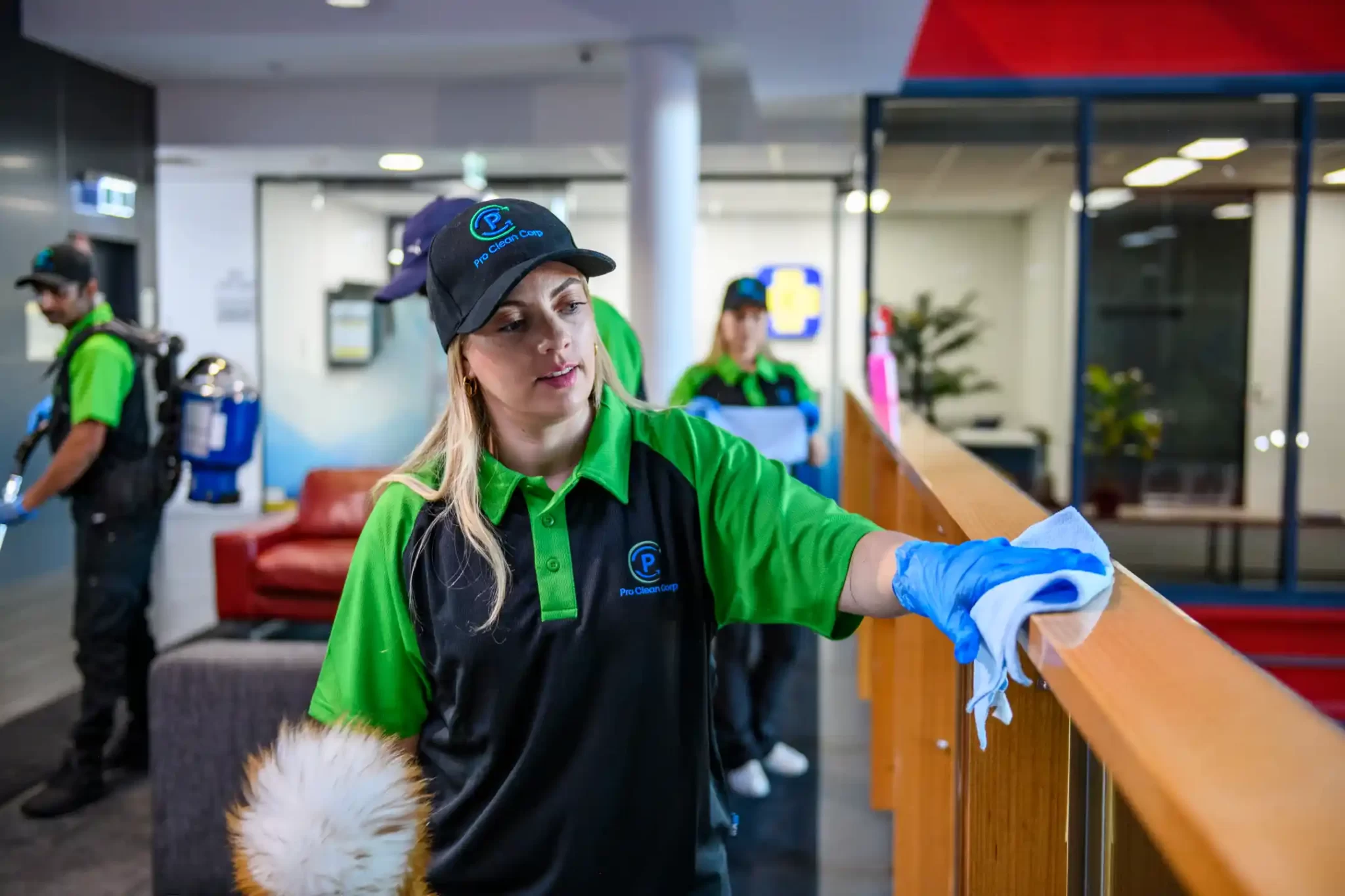
NHMRC-aligned medical centre cleaning services from Pro Clean Corp apply the right protocols for each clinical zone — TGA-registered disinfectants, documented infection prevention procedures, and colour-coded equipment to prevent cross-contamination. Our cleaning records support your RACGP accreditation and NSQHS Standards compliance obligations.
Medical centres present unique cleaning challenges that general commercial cleaners are not equipped to handle. Cross-contamination risks, the presence of bodily fluids, high-traffic patient areas, and the need for infection control compliance all require a specialist approach. Pro Clean Corp's medical cleaning teams are trained in healthcare facility sanitation and understand the critical importance of their role in patient safety.
We service GP clinics, specialist medical centres, allied health practices, bulk billing clinics, urgent care centres, and multi-disciplinary health hubs across Sydney. Our teams use TGA-registered hospital-grade disinfectants proven effective against a wide range of pathogens including bacteria, viruses, and fungi.
Our medical centre cleaning protocols are aligned with the NHMRC Australian Guidelines for the Prevention and Control of Infection in Healthcare. From colour-coded cleaning equipment and zone-specific procedures to TGA-registered disinfectants and documented dwell times, every step of our process is designed to meet the infection control standards required for RACGP accreditation and NSQHS Standards compliance.
Many practices ask us to look after more than the clinical floor. We frequently combine medical centre cleaning with professional office cleaning for admin and reception suites, full-premises commercial cleaning in Sydney, and strata cleaning for shared lobbies in multi-tenant medical buildings. Where a centre adjoins residential care, our aged care cleaning team applies the same infection-control discipline.
Bulk billing and private GP practices across Sydney.
Cardiology, dermatology, orthopaedic and all specialist rooms.
Physiotherapy, psychology, podiatry, and chiropractic clinics.
Large health hubs with multiple practitioners on-site.
Medical centre cleaning services are built in three tiers, and confusing them is the most common reason a practice feels its contract is underdelivering. The routine daily service covers reception and waiting areas, patient toilets, corridors, staff rooms, consulting room high-touch points, floors and waste. The scheduled periodic service covers what daily cleaning cannot reach: under and behind fixed furniture, chair upholstery and vinyl seating seams, blinds and window reveals, vents and returns, and floor restoration such as vinyl strip-and-seal or carpet extraction. The event-driven service covers terminal cleans after a procedure, blood and body-fluid spill response, and enhanced cleaning after a notifiable infection presents in the practice.
Within the daily service, clinical zones are not treated equally. A waiting room needs frequency because of throughput; a consulting room needs consistency at defined touch points (examination couch and rails, basin and tap, light switch, door handle, keyboard and mouse, blood pressure cuff housing, EFTPOS terminal); a treatment or procedure room needs a documented terminal clean matched to the procedures performed in it. Colour-coded microfibre and mop systems keep those zones separate — red for sanitary areas, blue for general surfaces, green for kitchen and food handling, yellow for clinical — so nothing travels from a patient toilet to a consulting bench.
Four documents drive how a medical centre is cleaned in Australia. The NHMRC Australian Guidelines for the Prevention and Control of Infection in Healthcare set the underlying method — standard precautions, cleaning before disinfection, correct contact times, and risk-based frequency. The NSQHS Standards, particularly Standard 3 (Preventing and Controlling Infections), apply to accredited services and require a documented, monitored environmental cleaning programme. The RACGP Standards for general practices require general practices to maintain clean, safe premises with documented infection prevention procedures. And the TGA register determines which disinfectants may lawfully be represented as hospital-grade — a product not on the Australian Register of Therapeutic Goods for that claim cannot be used to support your compliance position, however effective the marketing copy sounds.
Two details do most of the practical work. First, contact time: a hospital-grade disinfectant needs the surface to stay visibly wet for the period stated on the label — commonly five to ten minutes. Wiping it dry immediately, which is what a rushed cleaner does, converts a disinfection step into a cosmetic one. Second, clean before you disinfect: disinfectants are deactivated by organic soil, so a surface with visible residue must be cleaned first or the disinfection stage is wasted. Both are trainable, both are invisible in a finished room, and both are why healthcare cleaning is priced differently to office cleaning.
Most practices run a single after-hours clean, five to seven days a week depending on opening hours, with an early-morning option from 5:30am where a practice locks up rather than issuing keys. Higher-throughput sites add a mid-day service between morning and afternoon sessions, focused purely on waiting room seating, patient toilets, door furniture and reception touch points — the four surfaces that carry the most transmission risk during a busy day. Treatment and procedure rooms sit outside the routine schedule entirely and are cleaned on completion of the procedure. Periodic work is best locked to a calendar at the start of the contract, because periodic tasks that are only done “as required” reliably stop being done at all by month four.
Medical centre cleaning services include clinical area deep cleaning, waiting room and reception sanitation, treatment room disinfection, bathroom cleaning, high-touch point disinfection, medical waste area cleaning, and floor mopping with TGA-registered hospital-grade disinfectants. All work follows documented infection control protocols.
Medical centres require daily cleaning at minimum, with clinical areas cleaned after every patient session where possible. High-touch surfaces require multiple sanitisations throughout the day. We create custom cleaning schedules to meet your specific patient flow and clinical requirements.
Yes. All Pro Clean Corp medical cleaning staff receive specific training in infection prevention and control (IPC) protocols including standard precautions, proper PPE use, colour-coded cleaning equipment, and safe waste handling. We keep documented training records for all team members, and every cleaner is police-checked before working in a healthcare environment.
Yes. We specialise in after-hours medical centre cleaning to ensure your clinic is thoroughly clean and ready for patients each morning without disrupting appointments or staff workflows during operating hours. Early-morning and evening schedules are both available.
Yes. As well as GP and bulk billing clinics, we clean dental surgeries, physiotherapy and allied health practices, psychology and counselling rooms, and specialist consulting suites. Each room type receives a protocol matched to its clinical risk — for example a higher-grade terminal clean for treatment and procedure rooms, and routine sanitisation for waiting and reception areas.
The number is set by consulting room count far more than by floor area, because each room carries a fixed set of tasks regardless of its size. After that: the number of treatment or procedure rooms requiring terminal cleans, patient volume (a bulk billing practice seeing 300 patients a day wears its waiting room very differently to a specialist suite seeing 20), the number of patient bathrooms, floor type, whether consumables restocking is included, and whether you need a documented mid-day service between sessions as well as an after-hours clean. We quote a fixed price after walking the practice with your practice manager, itemised room by room, with periodic work such as floor restoration and window cleaning priced separately rather than buried in the recurring rate.
The RACGP Standards for general practices require practices to demonstrate that the premises are maintained in a clean and safe condition and that infection prevention procedures are followed and documented. Surveyors do not audit your cleaning contractor — they audit your evidence. Every visit produces a dated, room-by-room completion record signed off by the cleaner, backed by Safety Data Sheets for all products, TGA registration details for every disinfectant used, and staff infection control training records. Your practice manager receives a monthly summary. That package answers the cleaning-related questions in an accreditation cycle without anyone having to reconstruct twelve months of history from invoices.
Five questions separate a healthcare cleaner from a general commercial cleaner. First, is the disinfectant TGA-registered for hospital-grade use, and is the label contact time actually observed? A product wiped dry after ten seconds has not disinfected anything. Second, how is equipment zoned — ask to see the colour-coding, because one cloth moving from a patient toilet to a consulting bench undoes the visit. Third, are cleaners directly employed or subcontracted, and are police checks current? Fourth, what record is produced after each visit and will it satisfy an accreditation surveyor? Fifth, what happens on an exposure event — a blood or body-fluid spill, or a notifiable infection — and is that response included or billed separately?
For practices in the Sydney metropolitan area, see medical centre cleaning Sydney for local coverage and suburb pages; Hunter Valley practices should see medical centre cleaning Newcastle. Where a practice sits inside a larger tenancy, the clinical programme is usually bundled with commercial cleaning Sydney, delivered by the same commercial cleaners Sydney crews.
Protect your patients, staff, and practice with Pro Clean Corp's hospital-grade medical centre cleaning. Operating across all Sydney suburbs, 7 days a week.